Distractions, reflections

David Ing, at large … Sometimes, my mind wanders

A mundane visit to Yorkshire

My friend Ian says that I take the most mundane photographs of anyone he knows. I’m proud to say: the more mundane, the better. I’m really into local building and architecture, and how people live, work and play in their everyday lives — background social practices1. I find humour in my own preconceptions about the way that the societies work, with that bit of surprise that things can be done differently. With Jennifer generously allowing me to stay in her home, my visit to Pockington, Cottingham (the area about the University of Hull) and Kingston-upon-Hull (Hull itself) was full of these little mundane delights.

Small memories include:

  • Jennifer drove by Pockington post office in the morning, and sent Cameron into the back to pick up a package. The town is small enough that he could go to the back, without security guards or barb wire protecting the Royal Mail.
  • The drive in front of the circle has some other cars parked in it, and Jennifer deftly squeezed her car with about 2 inches on either side of it. I’m a relatively confident driver, but I would have been scared of scraping off some paint, and Diana wouldn’t have even attempted it. Jennifer’s got an amazing grasp of the size of her car. She proved this again later, doing a U-turn/three-point turn in a one-lane street from a parking space with cars parked on both sides, to go the other direction.
  • When we went grocery shopping at Tesco, we couldn’t find canned chicken stock so that I could make soup. (On the other hand, in Finland, Minna had doubts about finding chicken stock in her supermarket, but then found one litre packages of it in the “specialty food” section, as a new featured item). I guess soup-makers are classified as only those who start from whole chickens, and those who like it completely ready-made.
  • Out at a pub for a quick lunch with a professor before a class, he had a beer — 20 minutes before he was to start a class. (The teetotalling culture from IBM still lives in memory, although it was lifted when Lou Gerstner became CEO.)

I got to see a bit of the local scenery while doing errand runs.

  • Brian took me into town (Hull) while he stopped by a optician to pick up some contact lenses. We stopped by a bank branch in the centre of town — I think it only had two tellers. He did point out a few sights. The Beverley Gate was famous for being a key site in in the beginning of the English Civil War in 1642, but was demolished, so that lack of presence hardly stands up to it historicity. We viewed the ferry docks that are now rarely used, as land travel passes over the Humber Bridge, which held the world record as the longest single span suspension bridge for 17 years.
  • Jennifer needed a key cut, and discovered that the local man that does that in Pocklington closes for all of Tuesdays. (Many store owners close on Tuesday afternoons). We drove into Hull to stop at a store that I’ll nominate as best knock-off of a Home Depot that I’ve ever seen — down to the orange signs. They don’t cut keys. We tried another hardware supply store, that also doesn’t cut keys, and were given directions by a woman with such a thick Yorkshire accent that I couldn’t make out what she was saying. She had directed us to a mall, but we never did find it.
  • In Pockington, there are several neighbourhood “family butchers”. I assume that they don’t mean men with cleavers who make house calls!

Naturally, each university has its own quirks.

  • The Business School at the University of Hull has just moved into a newly renovated complex of buildings — a real showcase. The parking lots are on the back side, so employees naturally want to come in through the back door. The back door, however, was not really intended as an entrance, so there’s no pull or knob, and the door always has an impromptu stopper in it to allow people to enter.
  • The computers at the business school have security on the network locked down so tightly, that the physical address of the network card of my laptop had to be manually entered so that I could get access. (Network access is authored by software address at every other network in the world I’ve seen — and I’ve seen quite a few!)

Over time — maybe with too much study of “theory of practice”, I’ve tried to learn to not judge why things are done one way in one locale when they’re done another way in some other locale. People are (generally) smart, so there must be an explanation — although delving into how practices come about can really sometimes get convoluted.

(See more of Pocklington, Hull, and Yorkshire on the snapshot server in our basement).


1This philosophy is associated with phenomenology, including thinkers such as Heidegger: The Stanford Encyclopedia of Philosophy describes this idea in context: ” Phenomenology … leads into analyses of conditions of the possibility of intentionality, conditions involving motor skills and habits, background social practices, and often language, with its special place in human affairs”. 

Sunday brunch/church, train travel, and medieval York

After a long day on Saturday, I got a slow and relaxing start on Sunday with Martin, saw more English countryside on the trains, and got a tour of York highlights with Jennifer.

Martin had said that on Sunday morning, there was a church that I might enjoy, “not for worship, but as a stunning place to chill out”. I have to admit to not knowing Martin very well before this trip, and didn’t know exactly what to make of this before I arrived in Nottingham. It turns out that church has been completely renovated into an elegant restaurant — the Pitcher and Piano — and it serves brunch. In my quest for local cuisine, I had the lamb roast, served with more altitude than traditional English servings.

Martin dropped me off at the train station, making sure that I got onto the right track. Unlike my usual behaviour on airplanes, I didn’t feel much like reading or listening to my minidisc player, so I just people-watched and looked out the window at the English countryside. On the first leg, I was seated across from a mother, her one-year-old and four-year-old sons, and her aunt. I could barely understand their English through their accents. I try to not judge parents on their child-rearing styles, and was amused at the mother handling the four-year old. (The aunt claimed that he was a terror). The young boy wanted one of the the baby’s toy, and it was a battle of wills with the mother. My intuition tells me that her sons will grow up to be more competitive than mine.

I changed trains at Chesterfield station, onto a Virgin train. (They have nice interiors, and LCD panels over each seat indicating reservations). There were three young men travelling together, having fun and showing videos to each others on the mobile phones. They must have been 19-year olds, on their way to begin training in the army. I asked if they thought they would see action, and they said that the army was a “great way to see the world”. I didn’t press my view of the world on them, but got to reflect at the optimism of leaving small-town life and leaving the familiar behind. In my day, though, we didn’t have mobile communications for family to phone us up to say final farewells.

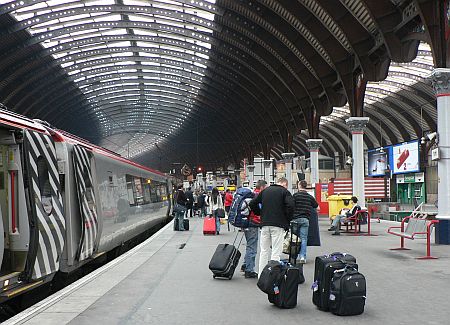
20060507_York_station.jpg

At York station, it seems that pay phone has become an extinct species, so the gentleman at the information booth allowed me to use that phone to call Jennifer. She was just minutes away. I thought Jennifer’s car — a Renault — was interesting, because we don’t see any of those in North America. We decided to take a quick look around York before heading off to Jennifer’s place in Pocklington. Since my usual walking tours are around markets and museums, we headed for the city centre.

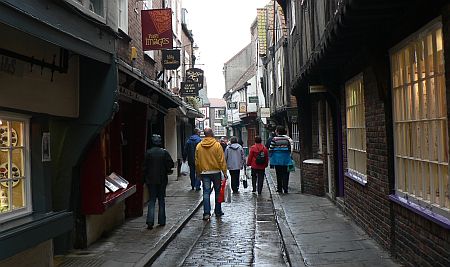
I had read a lot about the Shambles on the Internet, and I like to walk urban areas. The area has many of the original features from medieval days, although the butchers that gave the area the name have long since departed. The cobblestone streets were actually wider than I had expected. Most shops were closing in the late afternoon, but I wasn’t looking to buy anything, anyway.

20060507_York_Shambles.jpg

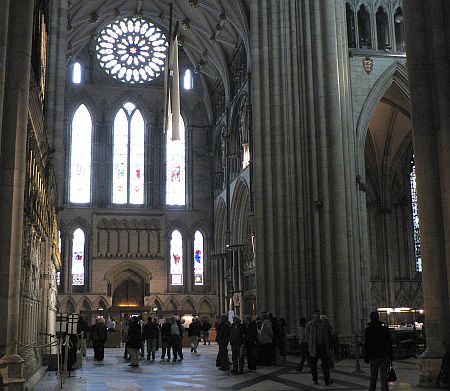
Jennifer led me over to York Minster. Describing York Minster as a cathedral is an understatement. Any one of the four or five major gathering places could easily be described as a cathedral with some grandure. Services were in session while we walked around the other areas, and we got to watch the choir promenading out. Unexpectedly, these students from the Minster School choir were all girls.

20060507_York_Minster.jpg

The drive to Pocklington revealed more of the English countryside. I saw lots of fields of yellow flowers, which I guessed as canola — known as rapeseed in the UK. Jennifer says that when the crop is mature, it emits a foul odour, so it’s possible to smell harvest season.

At Jennifer’s house, I unfortunately usurped her son Cameron from his bedroom, as he got to stay in the livingroom for the week. Jennifer’s house is in a small subdivision outside the centre of Pockington itself.

(See more of York on the snapshot server in our basement).

Planes and trains and visiting Nottingham

I haven’t seen much of England, in my past travels. I’ve been through London a few times on business, and had a vacation with Diana where we saw Slough, Oxford and Greenwich. On way to visit at the University of Hull, I thought I’d meet up with Martin Gladwell, on his home territory of Nottingham. I’ve heard that Nottingham is a fun town.

The day didn’t begin well, starting out to the airport. Petri had called for a taxi to pick me up a 5 a.m. for an early flight.  After getting caught up on a bit of e-mail and packing, I went to bed about 10:30 at night, … and the next thing I knew, light was just breaking and Petri was waking me up to say that the taxi was waiting. I had set multiple alarms, but must have set them all wrong! (That’s a stress signal for me!) I took a few minutes to quickly finishing packing the last few items into my suitcases. I got in the taxi, and arrived well in time for the flight. (The waiting taxi charged me an extra 20 Euros). The flights, routing from Helsinki to Copenhagen to Manchester, were relatively uneventful.

When I arrived at the Manchester airport, the customs officials wanted to check my baggage. This wasn’t like American customs check — the British official was quite friendly and relaxed. Afterwards, I asked why he thought to check me. He said that from my baggage tags, he could see that I had arrived on the Copenhagen flight, but he couldn’t tell from where. The customs officials weren’t busy that morning, so I guess that they had the opportunity to indulge every curiosity.

While in Finland, I was able to receive a text message from Martin on my mobile phone service, but it doesn’t allow me to reply internationally. Martin was waiting for me right outside the arrival area doors in the Manchester airport terminal. He had arrived from an IBM meeting in Madrid the previous evening, and stayed overnight in a hotel. I trailed him down to the train station, and he helped me buy tickets for trip to Nottingham, as well as to York on the next day. I made jokes that I was getting used to having all the arrangements done for me, because in Finland, it seems that my hosts (Minna, Taina, Ritva, Annaleena) can always get simple things done faster in the native language.

20060506_Manchester_airport_train.jpg

We changed trains at Manchester Piccadilly1. When travelling from one country to another on a single trip, I feel slight cultural dissonances. Certainly, the architecture in British train stations feature Gothic or Roman touches, whereas Finnish buildings are either Scandinavian modern or rustic (as in the old houses in Porvoo). On the train platform, the crowded space, the casual style of dress, and multitude of ethnicities was a completely different feeling from being in Finland. We waited for the train beside two old Chinese ladies carrying plastic shopping bags — as they would in Hong Kong or in Toronto — chatting in the Hoisan dialect (that my parents speak) about the price of groceries. I assume that whatever immigration policies prevailed in Canada in the 1960s and 1970s also prevailed in the UK.

We got onto a crowded car on the train, and seats were full. In the entry passage, I sat on the jump seat, and Martin sat on his suitcase. Chats with other passengers suggested that this train to Sheffield and then Nottingham often runs to capacity. Most interesting to me was the large number of passengers on the train going to watch the football game. They were carrying around large cans of beer in plastic shopping bags, and casually consuming them. I told Martin that I was unsure whether this was legal or illegal in Ontario, because it just isn’t done2. The football fans weren’t threatening — some came as complete families — but Martin warned that they could get loud. They gave me a good sampling of football songs and cheers as a natural part of their trip.

At Nottingham, we took a taxi back to Martin’s flat. I was intrigued the by the design of British “black cabs”: there’s no trunk, but an entry into a massive passenger space with doors wide enough to bring in luggage. If more passengers come in, there are jump seats (facing backwards). These are so practical, I wondered if anyone has ever tried importing them or building something similar in North America3.

20060506_Nottingham_taxi.jpg

We took a few minutes to drop off baggage at Martin’s flat, and headed out to catch a double-decker bus into the city centre of Nottingham. While it might have been nice to see Old Market Square before the construction started, it’s currently under construction to become the winning vision of a new public space. On a Saturday afternoon, the Broad Marsh Shopping Centre and pedestrian shopping streets were bustling. Nottingham has a great energy about it. Unlike many other places I’ve visited, the people don’t seem stressed, and many have smiles on their faces. Martin says that Nottingham is a popular place for stag nights and hen parties, so it’s not unusally to see troupes of women cavorting together while dressed alike (e.g. as nuns).

We stopped for some tapas at La Tasca — a bit of calamari, some chorizo, some (non-salty) anchovies. We stopped into St. Mary’s Church — it dates back to construction in 1376 — and I was amazed by the dates and inscriptions on some of the crypts built into its walls.

20060506_StMarysChurch_crypts.jpg

As it started to rain, we retreated in the City of Caves for a tour of underground Nottingham (literally). Actors told history about the medieval tannery pits — the tanners never caught the plague because even the rats couldn’t stand the smell — as well as the caves used as shelters during the bombings in World War II. Martin and I then wandered over by Nottingham Castle, where we looked at the Robin Hood statue and plaques on the wall.

20060506_Nottingham_Robin_Hood_statue.jpg

I was intrigued by two uniformed officers taking digital photographs of a very nice sports car parked nearby — and Martin informed me that digital images are a method of presenting evidence on parking tickets in the UK.

For a late afternoon break, we stopped by Ye Olde Trip to Jerusalem — which proclaims to be the oldest inn in England, back to 1189 A.D. Martin and I sat out in the courtyard, listening some boisterous drinkers in the main room singing pub songs (e.g. old Beatles sounds, Paul McCartney would be proud!) until the barman complained about the volume. I guess every bar has its limits. Martin had previously pointed out the Bell Inn, nearer to the center of town, that disputes the “oldest inn” claim. Dating “from timbers in the Bell Inn” reveals construction circa 1420, whereas Ye Olde Trip to Jerusalem’s “building itself dates from the 16th or 17th century” — although its “caves may date to the 11th century”. More interesting for Ye Olde Trip to Jerusalem is the Cursed Galleon in the Rock Lounge. It’s a model ship over the bar, and “last 3 people to clean it have all mysteriously died”.

We went back to Martin’s place so that he could have a quick nap, while I caught up on e-mail. For the evening, we decided on a Japanese restaurant for a quick dinner, and then on to a (relatively quiet and smoke free) pub. I might have been in the mood for some music — jazz or folk — but it seems that Nottingham gets so much business on weekends, that venues don’t need live music to attract customers. Music is something that happens on weekend nights. In any event, I got to meet Martin’s friend Roger, and we had an interesting conversation about rock musicians getting old. Roger’s band used to play progressive rock, so it’s a real challenge to remember guitar parts, not only because progressive rock can be intricate, but also because some pieces run 10 to 12 minutes in length!

By the end of the evening, I was pretty wiped out, so I was happy when Martin offered me his bed and he slept on the couch. It’s been a long time since I’ve stayed with a bachelor, so I’ve almost forgotten what living alone is like!

(See more of Nottingham on the snapshot server in our basement).


1I asked Martin about the etymology for piccadilly. He didn’t know. Geraldo Carneiro cites two alternative etymologies: “I’ve learned from Jorge Luís Borges a probably false, but delicious, etymology: “Piccadilly” was the place in which the Portuguese made his “pecadilhos” (little sins). Afterwards I learned from Anthony Burgess (funny as those two writers have the same name, signifying bourgeois) that the word “Piccadilly” came out of a family of fat people that created “pickardils”, that means healthy pigeons, if my precarious English does not fail (and it does!)”.  

2Now at home, I can see that the Alcohol and Gaming Commission of Ontario says that it’s illegal: “It is illegal to transport beverage alcohol in a motor vehicle, a motorized snow vehicle or a boat unless the beverage alcohol is in a container that is unopened and the seal unbroken, or unless the beverage alcohol is packaged in baggage that is fastened closed or is not otherwise readily available to anyone in the vehicle. In a boat, the beverage alcohol must be stored in a closed compartment.” 

3“Black cabs” appear to be all built by London Taxis International in Coventry. It turns out that there’s been a London Taxis of North America company out of Massachusetts since 2000, and they received a U.S. government approval for import as taxis in 2003.

Machine (man) down

After a week in Austria, but before my trip through the UK, my Thinkpad died in Finland!

Minna had picked me up from the airport on Thursday night (April 27), and I had a chance to plug in the Internet connection at her home to catch up. On Friday morning, I lectured at the class at Stadia and then went out for lunch and shopping in Hakaniemi with Ritva. I took the bus back to Minna’s house, plugged in my laptop … and the machine wouldn’t boot. My experience (as a former IBM systems engineer!) suggested that this was system board failure, and definitely a hardware problem. While I was puzzling through options, I made dinner.

After dinner, I got Minna’s permission to try an experiment. (This really made Petri uncomfortable, but I’ve done this dozens of times!) Since Nokia also uses Thinkpads, she happened to have the model similar to mine — a T41. I removed the hard drive from my Thinkpad, and put it into her machine. Success! Although her T41 came with a Finnish keyboard and better screen resolution, my hard drive started up as normal. I connected to the network, tunnelled into IBM, and started some Sametime chats with various internal support people. I finally connected by Mary Penner, in the IBM Canada CIO’s office. The solution was, it appears, to put the Thinkpad Emergency Replacement Program (TERP) into effect. This is a great program, designed a decade ago, when it was realized that IBM consultants can’t effectively do client work when they don’t have a working Thinkpad. The distribution centre maintains an inventory of identical model units, so that a replacement can be sent out, working parts (e.g. hard drives, memory) can be swapped as required, and the non-working machine is returned for repair. This works well in Canada, and the IBM consultant is back in business in about 24 hours. Maintenance facilities typically don’t keep system boards on hand, so getting local service isn’t an option.

Working abroad, however, is a bigger challenge. Since I was going to be in Finland for another week, Mary initiated a shipment for me — starting with ordering inventory pulled down in the distribution centre on Friday’s third shift — so that the appropriate customs paperwork could be done on Monday morning. On this schedule, the replacement Thinkpad was to arrive in Finland on Thursday.

I wrapped up as much work as I could on Friday night, and went to Porvoo on Saturday. The rest of the weekend — while Minna and Petri celebrated Vappu (May Eve and May Day) with friends, I worked on Minna’s Thinkpad, knowing that I’d have to return it when the work week began. I transferred some of the content to a memory stick, and stashed away various files on the Internet at daviding.com, because getting Internet access is easy.

Tuesday, Wednesday and Thursday, I was at Stadia and HUT, where Internet access on library computers worked well. I tracked the shipment of my replacement Thinkpad on the FedEx web site, and noted that it had arrived at the airport distribution centre on Thursday. On Friday morning, at IBM, Jyrgi Koskinen and Taina Gunay phoned FedEx for me. There was a bit of confusion about the customs status for the Thinkpad — it seemed like we were importing a computer from Canada — but they straightened that out. The computer was to arrive by lunchtime. I gave my scheduled presentations at IBM.

At lunchtime, Jyrgi phoned FedEx and they said that they would deliver by 2 p.m. We went down to the mailroom, and asked the clerks to watch for us. Around 2 p.m., Jyrgi phoned FedEx again, and they said that the shipment would definitely arrive by 4 p.m. The mailroom closes at 4 p.m., and this was a Friday afternoon! Coming up to 4 p.m., Jyrgi phoned FedEx again, and the dispatcher gave him the mobile phone number for the driver. The driver said that she was tangled in traffic, and would arrive soon. Jyrgi gave her directions to deliver to the front reception desk, so the mailroom employees could go home. I went downstairs to wait. An unmarked van pulled up around 4:30 p.m., and a woman rushed out with the package. Finally!

I took the Thinkpad upstairs, swapped the hard drives, and started up the computer. I was back in business. I found Mary Penner online in Toronto and thanked her, and asked about the return. She replied that she actually hadn’t initiated a formal TERP, but had assigned me a second Thinkpad. She said that the last time that she did a TERP to an IBMer in France, it took her six months to track the return through shipping and customs! I meant that I not only got to carry one Thinkpad in my hand luggage through the UK before coming home, but two! (More physical exercise than I really needed!).

Still, the process worked, and I would have a functional computer with me for my final week in the UK. That evening, it was a scramble between getting caught up on urgent e-mails, and packing up for a flight to Manchester in the morning ….

Entertaining at (someone else’s) home

In this stage of life where we all have full time jobs, families and community, entertaining friends at home is a small luxury. For me, entertaining in friends’ homes is a nice respite from jet age travel. It’s a great opportunity to share time, food and wine together.

Taina and Pekka hosted the dinner on this trip. Minna invited Tuula (since Petri and Tommi had prior commitments) and I invited Karlos. Annaleena had just returned from the U.S., but had picked up some stomach troubles on the trip, and thought it best to stay home. Taina chauffeured me over to the K Citymarket hypermarkets at Iso Omena — a reliable place to pick up Chinese-style tofu! — and I prepared about five dishes, as usual. Continue reading “Entertaining at (someone else’s) home“

A quiet afternoon strolling through Old Porvoo

In my travels, I’m usually happy to just get around the city that I’m visiting. There’s usually plenty to do around most urban areas — museums, markets, hangouts — and I get to know the local streets (on my folding bicycle) or local transportation. On my trip to Finland last November, I was feeling pretty burned out — even missing the outbound flight — and the dreary weather encouraged me to stay in the hotel and just work. (This was just before I figured out that I was having problems with my vision and would need a cataract surgery, so the whole situation may have foreshadowed that I was turning agoraphobic).

Usually, on one of the weekend days of my visits, Karlos and I usually take some time off, visiting Kiasma, or just having lunch and walking around the city — but we set a bad pattern on the last trip. In November, he first begged off going out because he was trying to meet a deadline in editing a book, and I then later begged off a dinner because I had to prepare for a lecture. Toward the end of that visit, we did get to meet for a nice dinner, but winter was setting in pretty early for other activities. I think that this trip is my eighth visit to Finland since 2003, but unusual in a strong probability for sunny weather and long days with light. I had suggested to Karlos that we might take the drive to Porvoo if the weather stood up. Continue reading “A quiet afternoon strolling through Old Porvoo“

  • RSS feed: Photo Microblog Photo Microblog

    • Cameron Harvey (2026) Ancestor 74
      Floor to ceiling #CameronHarvey (2026) Ancestor 74, from the series Family of Things. Impermanence inspired by chaparral shrub that survived fires in 2024 and 2025 but forever changed. Paint applied to unstretched canvas on floor with feet, knees and hands in symmetry. (Unversity of Toronto Art Centre, University College) 20261114
    • Chiedza Pasipanodya (2026) Machuma | The Cradle
      Shape of fruit from baobab trees, #ChiedzaPasipanodya (2026) Machuma | The Cradle suspends spheres of clay wrapped with herbs and fired from steel frame. Tradition encourages ancestral connectivity and future projection, travelling in and out of time. Part of Toronto Biennial of Art. (University of Toronto Art Centre, University College) 20261114
    • Dala Nasser (2025) Xiloma MCCCLXXXVI
      Recreation of 6th century Byzantine mosaic #DalaNasser (2025) Xiloma MCCCLXXXVI. Title combines ancient Greek for rupture, and Roman numerals for 1386 years before church floor was discoverd in 1862. Cyanotype fabrics were draped across wooden scaffolds exposed to sunlight. Fragmented installation representative of enduring dislocation from ancestral homelands. (Justina M. Barnicke Gallery, Hart House, University […]
    • Soon to be lit Christmas Tree
      Media crews preparing for Christmas Tree to be lit in about 90 minutes, after sunset. Deejay spinning tunes to energize audience positioning for optimal viewing. Barricade fences separating watchers from shoppers, many security guards guiding pedestrian traffic. (Eaton Centre, Yonge Steet, Toronto) 20261112
    • OCADU Field Trip to Contxt by Trane
      OCADU Arts Adminstration class field trip, #FrankFrancis interviewed by #PeterScott behind the science of operating a community space featuring jazz. After Trane Studio building overhead escalated, found welcoming generational landlord for Contxt space. This month, paintings by #HollisBaptiste on exhibition. (Contxt by Trane, Lansdowne Avenue, Toronto, Ontario) 20261105
    • New old mountain bike
      First ride after buying 1999 Kona 16" bike in palmer green off Kijiji. Previously owned two models in early 1990s, regretfully both stolen. Lighter than my other bikes, top reach is shorter, frame feels rigid. (Metropolitan United Church, Queen Street East, Toronto, Ontario) 20261104
    • Third visit to passport office
      Third visit to drop off grandson's passport application in person, not applying in California required confirmation by supervisor. First visit required letter from father, second visit requested photo with clearer stamp. Return via courier in 10 business days. (Toronto Passport Services, Victoria Street, Toronto, Ontario) 20261102
    • Halloween in the Upper Beaches
      Convened in neighbourhood enclave with grandparents-in-law for Halloween. Granddaughter hasn't yet reached first year, toured other homes for treats. Children's parade on street before sunset. (Upper Beaches, Toronto, Ontario) 20261031
    • Rebecca Baird (1993) A Time Within a Memory
      Created in collaboration with basket weavers from Walpole Island, #RebeccaBaird (1993) A Time Within a Memory. Sweet grass, seed beads, wood beads, porcupine quills, cotton thread. Part of the Returning to Ourselves exhibition, on loan from Global Affairs Canada Diplomatic Art Collection. (Onsite Gallery, Richmond Street West, Toronto, Ontario) 20261028
    • Michael Massie (2026) Do You Get the Point!
      Reimagining of child putting daisy into soldier's gun, #MichaelMassie (2026) Do You Get the Point! is a quieter bow and arrow. Brass, copper, woods, sinew. A more recent work in the Now and Then exhibition. (Onsite Gallery, Richmond Street West, Toronto, Ontario) 20261028
  • Meta

  • Fediverse daviding.com

  • Translate

  • Recent Posts

  • Archives

  • RSS feed: on Coevolving on Coevolving

    • Scholarship on systems theory and complexity in an age of Generative AI
      I’m impressed at the scholarship of Mark Downham, with the November 14 release of “Humans Are Not Estuaries“.  This work was in response to the November 13 release by Dave Snowden on “Not a branch of the tree” as part of the “What Is the Same and What Is Different series to position Anthro-Complexity”. What […]
    • Stephan H. Haeckel (1936-2025)
      I feel that I should honour Stephan H. Haeckel, who was the person that led me into #SystemsThinking in 1998 while on an assignment to the IBM Advanced Business Institute in Palisades, NY. Steve was working on Adaptive Enterprise: Creating and Leading Sense and Respond Organizations that was published by HBS Press in 1999. We […]
    • Problematique Dialogue 2026 retrospective
      From May 10-15, 2026, sLab convened the first Problematique Dialogue applying the Banathy Conversation Methodology, in the Graduate Studies building of OCAD University.  This brought together 26 participants in four teams, four facilitators, two methodologists, and two student volunteers. Ashok Mathur, VP of Research and Dean of the School of Graduate Studies, opened the event […]
    • Problem Solving, Problem Seeking
      As teams have been meeting online in preparation for the Problematique Dialogue event in May, there are some questions related to the Banathy Conversation Methodology.  There’s an emphasis on generative dialogue, over strategic dialogue. In the dialogue scholarship community there is a shared understanding that dialogue is not a new tool for addressing specific issues […]
    • Re-introducing sLab, Problematique Dialogue Call for Participation, 2026-02-25
      At OCAD U Graduate Programs, we convened an event to formalize (i) Re-introducing sLab, and (ii) announcing the Call for Participation for the May 2026 Problematique Dialogue, applying the Banathy Conversation Methodology. Peter Scott served as the moderator for the afternoon.  Greg Van Alstyne spoke about the sLab, as a unit first founded in 2008, […]
    • Problematique Dialogue + Conversation as Process and Connection | Systems Thinking Ontario | 20260209
      With a history of Banathy Conversations hosted by the International Federation for Systems Research (IFSR, 1982-2018) and the Creative Systemic Research Platform Institute (CSRP, 2024, 2025), the 139th meeting of Systems Thinking Ontario online was scheduled to provide more background on an upcoming in-person event planned for Toronto. Since fall 2025, the reinvigoration of the […]
  • RSS feed: on Media Queue on Media Queue

  • RSS feed: on Ing Brief on Ing Brief

    • 2026/01/07 | Rama Akkiraju | From LLMs to Living Systems: Applying Systems Science to Agentic AI in the Enterprise | HICSS-59 Keynote
      Abstract Enterprise AI is transitioning from simple single-LLM flows to complex agentic ecosystems—adaptive systems composed of multiple agents, tools, governed data, human workflows, and organizational policies. This keynote introduces a systems-science framework for designing and managing such ecosystems using principles of modularity, control, feedback, robustness, and socio-technical alignment. We illustrate these concepts through practical examples […]
    • Timothy F.H. Allen passed away on May 01, 2025
      Timothy F.H. Allen, president of International Society for the Systems Sciences 2008-2009, passed away peacefully in his home, surrounded by his family, on May 1, 2025. With his work on ecosystem ecology, I learned more about living systems than anyone else in the systems community. After his retirement, he was proud of putting together a […]
    • Installing WordPress Studio on Manjaro Linux
      In 2024, WordPress Studio was released, making installation on a local computer simpler. The instructions were modified from MacOS to Ubuntu Linux, by Daniel Kossmann, “How to install WordPress Studio in Ubuntu Linux” | Jun 15, 2024 at https://www.danielkossmann.com/how-to-install-wordpress-studio-ubuntu-linux/ I already had NVM installed, but in Terminal, with the result “command not found”. In the […]
    • Notion of Change in the Yijing | JeeLoo Lin 2017
      The appreciation of change is different in Western philosophy than in classical Chinese philosophy. JeeLoo Lin published a concise contrast on differences. Let me parse the Introduction to the journal article, that is so clearly written. A-theories divide time into past, present and future, and the point of reference is set at “the present.” B-theories, […]
    • World Hypotheses (Stephen C. Pepper) as a pluralist philosophy [Rescher, 1994]
      In trying to place the World Hypotheses work of Stephen C. Pepper (with multiple root metaphors), Nicholas Rescher provides a helpful positioning. — begin paste — Philosophical perspectivism maintains that substantive philosophical positions can be maintained only from a “perspective” of some sort. But what sort? Clearly different sorts of perspectives can be conceived of, […]
    • The Nature and Application of the Daodejing | Ames and Hall (2003)
      Ames and Hall (2003) provide some tips for those studyng the DaoDeJing.
  • Creative Commons License
    This work is licensed under a Creative Commons Attribution-NonCommercial-ShareAlike 4.0 International License
    Theme modified from DevDmBootstrap4 by Danny Machal