Distractions, reflections

David Ing, at large … Sometimes, my mind wanders

2006/07/08 Sonoma redwoods and wineries

I’m personally finding the challenge of keeping up with blogging on a regular basis, so I think that I’ll write less text, and show more photos. This will be a test of whether a picture is worth a thousand words! (I’ll have to manage down the backlog!)

I’ve been scheduled to attend the ISSS 2006 meeting at Sonoma State University for some time. I flew down a few days early to deliver a presentation at the IBM Almaden Research Center in San Jose. In my 22-year career at IBM, I’ve never been at that location. While in the peninsula, Craig came over to my hotel after work, and we had dinner in a local Chinese restaurant. I continued up to Sonoma, and Craig drove up to spend the day touring the area with me on Saturday.

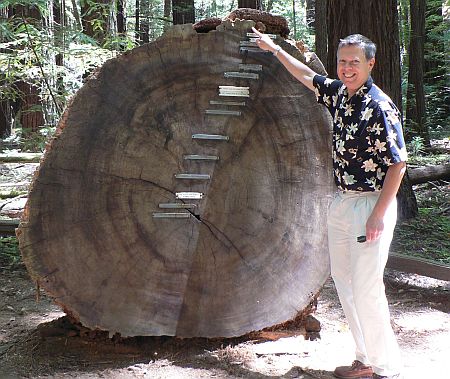
20060708_Armstrong_Redwoods_age_CDK.jpg

Continue reading “2006/07/08 Sonoma redwoods and wineries“

From Canada, international SMS is available … to some countries

It’s funny what you learn while on hold. Since it looks like I’ll be travelling to the U.S. a lot more in the near future, I phoned Bell Mobility to have my plan changed from a Canada-wide plan to a North American plan. (Those U.S. roaming charges get expensive really quickly, so it’s a small move to save the company some money). On the hold messages, the recording said that I could check on the international SMS message plan by typing bell.ca/internationalmessaging into my web browser.

Sure enough, the list says that I can send text messages to China Mobile, which is Adam’s provider in China. This supposedly should only cost 20 cents. Strangely enough, there two places where I would really like to use SMS aren’t on the list: Finland, and the United States (which may not count, as part of North America)!

When I’m in Finland, I’m used to using t9 to enter text input, but it’s really annoying. I’m going to have to consider alternative methods on my next phone. Maybe I should just get a Bluetooth phone, because I can send text typed in from my Palm TX. I wonder what happens when I’m roaming on my Canadian phone in the U.S.

Revisiting RSS reader choices

I’ve been using RSS Bandit as my RSS reader since February, and have been quite happy with it. However, I started getting read errors that I reported on the RSS Bandit forums, and after 6 messages back and forth, the errors remain unresolved. I’m quite a bit behind on my reading, so I like to keep a long history of RSS feeds, and unexplained interruptions are annoying. After a week of not getting resolution, I started shopping around for another Windows-based RSS reader again.

One feature that makes moving from one reader to another relatively simple is OPML. Export the list of subscriptions from one package, and import them into another. There’s a few complications that make moving from one package to another less than completely straightforward, that I’ll describe further below. Here’s a trace of my reasoning for selection, based on a process of elimination.

RSS Bandit v.1.3.0.42 GreatNews 1.0 Beta (Build 370) RSSOwl 1.2.1 Feedreader 3.05 Abilon 2.5.3 build 196p
OPML Export and import Export and import Export and import Export and import Export and import
Tolerates Blogspot Atom 0.3 errors with Microsoft tags No Yes No Yes Yes

OPML: In theory, the ability to import and export OPML means that it should be easy to move from one RSS reader to another, if something doesn’t work out. In practice, this turns out to not quite be true. I had 2 levels of folders in RSS Bandit, and trying to import that into other packages didn’t work that well. One level of folders seems to be okay, so thinking flat has merit.

Tolerates Blogspot Atom 0.3 errors with Microsoft tags: Now that Blogger does RSS 2.0, it’s a bit moot about whether an author chooses to use Microsoft Word as an editor or not, resulting in Atom 0.3 non-compliant feeds. However, this symptom speaks to a greater issue about whether a developer is responsive to practices-in-use, or prefers to stick with standards as written. In the world of browsers, web page writers are always checking that content works on IE, Firefox (and even Safari), so it’s annoying, but the alternative of telling web users what packages they should use is not very helpful. Thus, from my list, I eliminated RSS Bandit (which I actually liked a lot) and RSSOwl.

GreatNews 1.0 Beta (Build 370) Feedreader 3.05 Abilon 2.5.3 build 196p
Ongoing development and support Active Active Dead

Ongoing support and development: RSSOwl has a pretty active open source community, so it’s too bad that I eliminated it on the above grounds. RSS Bandit has had a history of active development, but the key resources seem to have been busy for quite a while, so updates have been recently been slow. Abilon was written up by PC World, and is downloadable from their site, but the original site of abilon.org is no more. The developers have moved on. If Abilon was really a killer package with features way beyond the others, then I might consider it. Abilon would do the job, but the lack of any future support worries me, so I eliminated it from the final choices. Although GreatNews and FeedReader don’t appear to have large developer communities, they are signs of continuing development..

GreatNews 1.0 Beta (Build 370) Feedreader 3.05
Notifications and alerts Refreshes can be set feed-by-feed Refreshes can be set feed-by-feed
Look-and-feel Buttons readily at hand Cleaner interface, options hidden

Notifications and alerts: It doesn’t take long to refresh even a long list of feeds, but sometimes I just don’t think about my RSS reader, so it’s good to prompt me on certain feeds that I consider more important. In RSS Bandit, it was possible to set the refresh rates at the folder level, and all of the contained feeds would inherit those periods. In both GreatNews and Feedreader, they’re set feed-by-feed, which is rather annoying, but not enough to stop me from using them.

Look-and-feel: This part is most subjective. I had gotten used to RSS Bandit’s layout flexibility — the ability to move the reading pane to the top, and button bars onto the right side. Feedreader hides most of its options behind the menus, whereas GreatNews surfaces the options, and there’s more options available. As one example, the size of the panes in Feedreader can be adjusted by dragging the borders. GreatNews has the additional feature that clicking on the centre border instantly maximizes the reading pane. GreatNews just feels like a package with an interface that a frequent user would build … not that Feedreader couldn’t get there some day.

For now, the winner … by a nose … is GreatNews. It’s possible that this could change over time, and using an OPML export and import makes moving from one to the other somewhat easier. Going through a long list and resetting refresh rates one by one is enough to deter me from making the switch back-and-forth with any frequency.

Now that I’ve used GreatNews for some time, there’s two features that I miss from RSS Bandit.

  • After reading a number of entries in RSS Bandit, I could select and then shift-select a number of headlines and simply delete them. GreatNews does allow deletion of each headline separately, but select and shift-select isn’t a key combination that seems to work. This does work in Feedreader. GreatNews has been reminding me of an option to do a cleanup — the default was initially set up to 31 days — but that’s not the way I use an RSS reader. I let things accumulate at different rates, and then would like to do mass deletions manually. I turn on and turn off certain folders of subscriptions to my local newspaper, depending on whether I’m travelling or at home (where I read the hard copy).
  • GreatNews reminds me of feeds that have not been updated for some time, and asks whether I want to retain that feed on the list or not. This choice then gets hidden, so I don’t remember which ones are active and which ones aren’t. In RSS Bandit, the logs of failed feeds was retained, so that it was easy to look to see if I should or shouldn’t be concerned.

These may or may not be features on someone else’s priority lists, but for now, I’m pretty happy.


Update on 2007/01/01: Readers will probably be interested to read an addendum on RSS Readers: both for full content and excerpts-only.

Jane Jacobs, A Public Celebration, in Toronto

Last night, Trevor and I went across town to the Trinity St. Paul’s Church — in the Annex — for “Jane Jacobs: A Public Celebration“. It was a wonderful evening of music and thought, including some readings from her works.

Jane Jacobs passed away in April. This event was organized by John Sewell, a former mayor of Toronto, who was described as “disciple” of Jane. The ground floor of Trinity St. Paul’s Church was filled to standing room, and the balcony was about half full. The attendees seemed to include both people from the neighbourhood who had known Jane, as well as some had travelled from a longer distance.

  • Mary Rowe, president and editor of Ideas That Matter, acted as the master of ceremonies for the evening. She said that Jane wouldn’t have liked this gathering if it was about her. She could, however, warm up to the gathering as a discussion of her ideas. Jane liked debate, and liked having people come to her house to discuss ideas.
  • Ken Greenberg, former Director of Urban Design and Architecture for the City of Toronto, related Jane’s history, as she moved from New York to Toronto. Jane was offered honourary degrees multiple times, but chose to turn them down. Given a choice between celebrity and work, she chose work. Although many have pegged Jane as a pure urbanist, in recent years she spent a significant amount of time in the Toronto suburbs observing and trying to understand how they worked.
  • Ann-Marie MacDonald, a Toronto-based writer and actor, read from Cities and the Wealth of Nations. She read a passage on import substitution, describing the roles that cities played in the a funeral in the south (i.e. the casket, clothes, nails, etc. all came from cities from the north).
  • A quartet, led by Caitlin Brom-Jacobs (oboe) — Jane’s grand-daughter and a graduate of the Eastman School of Music — with Michelle Zapf-Belanger (violin), Carolyn Blackwell (viola) and Anne-Marie Zapf-Belanger (cello), played a Mozart Quartet for Oboe and Strings. The performance was quite moving, and the sound (from our seats in the balcony) was wonderful.
  • A video montage of Jane including segments of her on the streets in Toronto wearing an afghan, and in conversation at home. She described the way she thought as web thinking — perhaps an emphasis on part-part interaction from systems thinking.
  • Vince Pietropaolo, photographer and town planner, described a course from a college in upstate New York called Two Cities, which included a visit by students to New York City, and then to Toronto — ending up on Albany Street, where Jane lived. He read an article from The Village Voice on April 18, 1968 republished in Ideas That Matter: The Worlds of Jane Jacobs, where Jane disrupted a civic hearing, was arrested, and then released by police due to crowds calling for her freedom for two hours.
  • Anne Collins, Jane’s editor from Random House Canada, said that she could hear Jane’s voice in her head but couldn’t quite reproduce the sound. Looking at the cover of Dark Age Ahead, she said that she wished that should could have convinced Jane to put her name on two lines, so that it would read Jane … Jacobs. She said that she was tempted to read from the footnotes, because they provide depth to the body of the chapters. Anne started reading from near the end of the book, and then made the joke that since she was Jane’s editor, she would skip over some of Jane’s explanation to read the final paragraph of the book.
  • Max Allen, a producer from the CBC, introduced a recording of Jane’s 1979 Massey Lecture, that would become The Question of Separatism: Quebec and the Struggle Over Sovereignty. Max pointed out that the discussion on transfer payments is back in today’s headlines. In Canada, three of the provinces are clearly in surplus, and six are clearly in deficit, but Quebec is so close to balancing its books that its separation from Canada could potentially have minimal economics effects (on at least that dimension).
  • The Flying Bulgar Klezmer Band played three tunes. David Buchbinder said that Jane had come to the release party of their third CD, not as a celebrity, but just as someone who was easy to talk with. Dave Wall made a quip that klezmer music can be appropriate for any occasion, because no one understands what the words are about. The final song had a dozen dancers in a chain prancing up and down the aisles between the pews.
  • Margie Zeidler, recipient of the 2003 Jane Jacobs Prize, said that she would give the perspective of a 10-year, since she had known Jane for 30 years. Jane was first introduced as a famous writer, but since Jane didn’t write Nancy Drew novels, Margie wasn’t impressed. They had many conversations where Jane was quite interested in listening to Margie’s thoughts, and Jane occasionally chiding Margie when she wasn’t thinking straight.
  • John Sewell read from Systems of Survival, at the point at which Kate describes how she came about to categorize behaviours into commercial and guardian syndromes. This emphasized a difference that, unlike other animals, human beings can be commercial.
  • R. H. Thomson, a renowned actor, described how after being away for a few weeks in other places, he comes home twice: once to his wife, two sons and dog, and then to Bloor Street, where he knows the shopkeepers. He read from The Death and Life of Great American Cities, where Jane describes an entire day on Hudson Street in New York, where she used to live.
  • Mike Ford, on guitar and then piano, performed two songs. In “Stars shone on Toronto”, he described a peaceful city in the darkness of a power failure. He then sang “Crossroads”– written for the Ideas That Matter conference in 1997 — which includes the lines …
    • The world’s at a crossroads — this town’s at a crossroads
      Jane Jacobs help us decide how it unfolds and what we should do …

    with the audience singing along in the choruses.

  • The evening closed with a second video montage of Jane at her typewriter and pulling sheets from her stacks of notes. Jane said that she was most proud of her work in Cities and the Wealth of Nations, because that was her largest intellectual contribution.

I see that there’s supposed to be a similar event in New York on June 28, but can’t quite get all of the details.

In doing the searches for web links for this posting, I note that Ideas That Matter volume 3, number 3 includes commentary on Dark Age Ahead, as well as some other authors that I wouldn’t have expected in traditional pegging of Jane Jacob’s work as “urban planning”. These include Robert Lucas (1995 Nobel Laureate in economics) and Henry Mintzberg (from management). I think that I’ll take a break and read a bit more ….

Contact lenses and glasses — both!

I’ve been feeling fine since the cataract surgery, but having surgery to only one eye has resulted in a slightly annoying condition. While the vision in my left eye is 20/20, the vision in right eye is about -6. To make things more complicated, I was told by the intern that my left eye had been about -6, and the surgeons put in a lens with a correction factor of 8. This overcorrection complicates reading and working on the computer, because the left eye is bad on short vision, and I’m totally myopic in the right eye. Trying to wear my old glasses with the left lens popped out doesn’t work, because the images from left and right eyes don’t line up. The interim solution has been to wear my right contact lens — which I normally used to wear about 8 to 10 hours per day — now from the time I get up until the time I go to bed, and also wear drug store reading glasses (strength +2) to get by on the computer and reading.

So, I was really looking forward to today’s appointments. First, I had the opthamologist appointment this morning. This was one of the those “wait two hours for a 5 minute appointment” stories. My eye has healed well, and I haven’t any any infections, so the Dr. Squires congratulated me and showed me the door. (He said that I could come back in one year for a checkup, but didn’t seem all that motivated to say that. He seemed to prefer that I come back when my right eye needs a surgery — which will probably be in 20 to 30 years!)

Diana had told me that on her last visit to an opthamologist, the doctor said that a patient may be better off at with an optometrist for getting eyeglass prescriptions, because an optometrist has better equipment and fits lenses all of the time. Thus, I had scheduled an afternoon appointment with Dr. Eddie Chow. Dr. Chow is a family institution, since he fitted me with my first contact lenses around age 17. (He also fitted my sister Jeanne and brother Ben). He’s also the one who prescribed ortho-k (i.e. wearing hard contact lenses while sleeping) for Adam.

For the past few year, I’ve had three pairs of eyeglasses: one for long vision (e.g. driving), one for reading, and one for computer work (i.e. intermediate distances, with Zeiss multifocal lenses so that I can look at some paper documents without changing glasses). Diana and I stopped by Superb Optical on Friday night to look at a fourth set of frames. I thought that I would change the left lens in the three old eyeglasses for when I’m not wearing the contact lens, and would then need new frames for working on the computer when I am wearing the contact lens.

I was surprised today when Dr. Chow said that computer and reading eyeglasses could only be fitted above my wearing the contact lens in my right eye. When the difference between two eyes is so wide, glasses won’t work. (I guess I might have suspected this, from popping out the left lens from my old glasses!) The other unattractive options are:

  • get a contact lens for the left eye — correcting the eye that just had surgery(!) with a multifocal prescription;
  • get LASIK on the right eye to fix the myopia — uggh!; or
  • have a cataract surgery on the right eye — which definitely isn’t covered by provincial health care, and is purely elective, because I really don’t need it — at least for a few decades!

I’m not used to wearing contact lenses from waking up to going to sleep, so my first response was denial. Dr. Chow wrote me up a prescription for multifocal eyeglasses (both for computer work and reading), and told me that I’d have to figure this out for myself.

I went out front to Superb Optical, and immediately saw Edmond, the optician. (He’s another institution!) I asked how long it would take for the multifocal lens, and he said that it would take a week to get one from Zeiss. As an alternative, he suggested that I have separate eyeglasses for computer/intermediate work, and for reading. These lenses would then be all single-vision, and he could make them up while I waited. One consideration was that single vision lenses are relatively cheap, so it’s more practical to try this way first, and then order the multifocal lens in the future if I really felt I need it. I gave him the two newer eyeglass frames that I already had, and he put the new lenses in. It was $50 for four lenses, which seems cheap compared to the history of eyeglasses I’ve had in the past.

While I was having this discussion with Edmond, Dr. Chow walked by, and insisted that I really should have the multifocal lens! (I know that he uses them himself, because he uses optical equipment while seeing patients, and then has to read and write on paper). Edmond says that the optometrist doesn’t always know the best way. I’m usually all intermediate distance — 8 to 10 hours per day on a computer — or all reading — checking the newspaper in the morning, and then maybe studying some academic texts later. I’m picky about my focus — I think that I’ve spent too many years in photography! — so I’ve opted for two pairs of eyeglasses. This is ironically better than my past 3 years carrying around three pairs of eyeglasses!

There is some good news about my condition. I’ve been wearing hard (gas-permeable) contact lenses for 30 years, so in the grand scheme of changes, my having one in my right eye isn’t such a big deal. Dr. Chow said that he has older patients that would benefit by doing as I am, but they can’t get used to wearing a contact lens, and things don’t work out. For me, I can’t warm up to the idea of elective eye surgery, so the single contact lens is the answer. I wonder if I’m going to have issues when my eyes water up in hayfever season, though ….

20/20 vision in my left eye

What a difference a day makes! As scheduled (for some months now), I had my cataract surgery yesterday. This morning, I went for the post-op checkup, and I now can report 20/20 vision in my left eye.

Yesterday, my surgery was scheduled for 1:35 p.m. Diana and I went the requisite 2 hours early, and checked into the day surgery clinic (on the fifth floor at St. Michael’s Hospital). It’s been designed as a welcoming place — some benefactors must have spent some time there! — with a wood panel reception area. We were directed down a very long hall — the place is huge — and were given a cubicle large enough for a reclining chair and two guest chairs. The curtain was drawn in front, and I was given the usual hospital gown (actually designed with a side slit) and a very large white terry bathrobe. I removed my street clothes, and was down to underwear and socks under the bathrobe. The nurses went about to correct the attendant who had brought me down: for cataract surgery, they’re only interested in the head, so I could actually have kept my pants on. I opted to stay in my underwear, because it’s about as comfortable as being in my shorts at home.

A nurse came in to do the usual medical history, and put a catheter in the back of my right hand for the anaesthetic. Diana and I chatted for for about 45 minutes until the intern came. At that point, I handed over my glasses to Diana, so I wasn’t seeing much, either out of the left eye with the cataract, or my normal myopic right eye! I was wearing little booties over my socks, and the staff decided that I might as well walk down to the operating room (rather than take a wheelchair).

As the operating staff introduced themselves — it was impossible for me to make them out without my glasses! — I got up onto the operating table. They put a folded towel under my head, and then — rip, in a sound like a roll of Scotch tape! — they wrapped a strip of tape over my forehead and under the operating table. I remarked that this seemed primitive, but obviously functional. The staff bundled me up in warm towels, including a little tunnel for my left arm. I remember the nurse introducing herself, as she must have connected the catheter in my right hand to the anaesthetic. I remember the intern telling me that he was going to clean my left eye with three swabs of cleanser, counting 1 … seeing yellow … counting 2 …. and then … I don’t remember much.

In the pre-admission visit, the doctor had said that cataract surgery calls for a light anaethetic, because the patient has to be awake to respond to requests to move the eye. I can imagine that I was awake, but I really don’t remember anything. I do remember a few voices as they were working through the surgery … it sounded like they were having a little difficulty getting out my cataract, and I heard when they said that the artificial lens was put in … but everything else is pretty much a blur. I barely remember them taking off all of the blankets, getting down off the operating table, and then getting wheeled down to the recovery area. The surgery probably took about an hour.

The nurses asked me for Diana’s name, and she got paged to join me. (She doesn’t get called as Diana Ing very often). The nurses took my blood pressure, and gave me a turkey sandwich and apple juice. (It was annoying to be fasting since midnight the night before, but I was the last surgery of the day). I wasn’t feeling any real pain, just a slight sensation of a dry eye. I put on my street clothes, got in a wheelchair pushed down to the front door, and Diana and I took a cab home.

At home, I had some soup (I was on a cooking spurt on Saturday, having found tarkeys on sale for half price on Friday!). I watched tv in bed, and put in eye drops every hour. I guess that I fell asleep about 6:30 p.m., for a few hours. When I woke up, I decided to pop out the left lens from my glasses, which seemed to show that I had normal vision in the left eye, but I really couldn’t get my right and left eyes to line up. I had some cereal, watched some more tv, and went to sleep.

This morning, I had a shower, and decided to put in my right contact lens so that I could wear sunglasses to my post-op appointment. (It’s actually a rainy day). I actually haven’t worn contact lenses since last June, because my optometrist then said that glasses would allow more light into my left eye. Now, however, a contact lens works best. There’s no disparity, as with a pair of glasses with only the right lens in. One thing that I do notice is a slight colour difference between my eyes: the right eye has a slight yellow tinge in it, as I guess my natural lens is getting old.

Diana drove me over to the eye clinic. As we were passing over the Richmond Street viaduct, it’s interesting to observe how blind I was in driving with the cataract in one eye. Sure, I could see, but it was pretty much tunnel vision. With two eyes this morning, I could see traffic, the building, the trees. It was an amazing, joyous feeling.

At the eye clinic, the intern saw me first. He looked into the eye, and said that the lens was perfectly centered. I read the eye chart, and he said that I have 20/20 vision. I asked about the lens that they put in yesterday. He said that my eye is about 6, and they put in a lens to correct to 8. Of course, the downside is that I’m now farsighted in the left eye, so I really need reading glasses. The intern said that the human brain will adapt, so I’ll probably start reading more out of my right eye. He also said that my left eye is still dilated, so my vision should improve over the next few days. He was a bit concerned about a bit of pressure in my eye, but Dr. Squires, joining us, mentioned that the pressure was there before the surgery. I asked what I can and can’t do until the final checkup in three weeks, and Dr. Squires said no jumping up and down — so there goes badminton — no heavy lifting or exertion — so there goes bicycling — but otherwise I can live pretty normally (including showering!)

I’ll get fitted for glasses at the appointment in three weeks. In the meantime, my long vision is great, but with drops in my eye from this morning’s exam, it’s hard for me to judge what life will be like over the next three weeks. In a reversal of the condition before the operation, I can see long distances well enough to drive, but have found newspaper type to be illegible. I’ve been playing with the font sizes on Windows XP, so I can be functional on the computer — albeit with less screen real estate!

[Blogging note: I’ behind maybe 6 posts on multiple blogs, so I’ll be playing catch up over the next few days. WordPress has a feature that enables changing posting dates, so the entries on Fuschl, Finland, Manchester and Hull will still appear in correct date order.]

  • RSS feed: Photo Microblog Photo Microblog

    • Cameron Harvey (2026) Ancestor 74
      Floor to ceiling #CameronHarvey (2026) Ancestor 74, from the series Family of Things. Impermanence inspired by chaparral shrub that survived fires in 2024 and 2025 but forever changed. Paint applied to unstretched canvas on floor with feet, knees and hands in symmetry. (Unversity of Toronto Art Centre, University College) 20261114
    • Chiedza Pasipanodya (2026) Machuma | The Cradle
      Shape of fruit from baobab trees, #ChiedzaPasipanodya (2026) Machuma | The Cradle suspends spheres of clay wrapped with herbs and fired from steel frame. Tradition encourages ancestral connectivity and future projection, travelling in and out of time. Part of Toronto Biennial of Art. (University of Toronto Art Centre, University College) 20261114
    • Dala Nasser (2025) Xiloma MCCCLXXXVI
      Recreation of 6th century Byzantine mosaic #DalaNasser (2025) Xiloma MCCCLXXXVI. Title combines ancient Greek for rupture, and Roman numerals for 1386 years before church floor was discoverd in 1862. Cyanotype fabrics were draped across wooden scaffolds exposed to sunlight. Fragmented installation representative of enduring dislocation from ancestral homelands. (Justina M. Barnicke Gallery, Hart House, University […]
    • Soon to be lit Christmas Tree
      Media crews preparing for Christmas Tree to be lit in about 90 minutes, after sunset. Deejay spinning tunes to energize audience positioning for optimal viewing. Barricade fences separating watchers from shoppers, many security guards guiding pedestrian traffic. (Eaton Centre, Yonge Steet, Toronto) 20261112
    • OCADU Field Trip to Contxt by Trane
      OCADU Arts Adminstration class field trip, #FrankFrancis interviewed by #PeterScott behind the science of operating a community space featuring jazz. After Trane Studio building overhead escalated, found welcoming generational landlord for Contxt space. This month, paintings by #HollisBaptiste on exhibition. (Contxt by Trane, Lansdowne Avenue, Toronto, Ontario) 20261105
    • New old mountain bike
      First ride after buying 1999 Kona 16" bike in palmer green off Kijiji. Previously owned two models in early 1990s, regretfully both stolen. Lighter than my other bikes, top reach is shorter, frame feels rigid. (Metropolitan United Church, Queen Street East, Toronto, Ontario) 20261104
    • Third visit to passport office
      Third visit to drop off grandson's passport application in person, not applying in California required confirmation by supervisor. First visit required letter from father, second visit requested photo with clearer stamp. Return via courier in 10 business days. (Toronto Passport Services, Victoria Street, Toronto, Ontario) 20261102
    • Halloween in the Upper Beaches
      Convened in neighbourhood enclave with grandparents-in-law for Halloween. Granddaughter hasn't yet reached first year, toured other homes for treats. Children's parade on street before sunset. (Upper Beaches, Toronto, Ontario) 20261031
    • Rebecca Baird (1993) A Time Within a Memory
      Created in collaboration with basket weavers from Walpole Island, #RebeccaBaird (1993) A Time Within a Memory. Sweet grass, seed beads, wood beads, porcupine quills, cotton thread. Part of the Returning to Ourselves exhibition, on loan from Global Affairs Canada Diplomatic Art Collection. (Onsite Gallery, Richmond Street West, Toronto, Ontario) 20261028
    • Michael Massie (2026) Do You Get the Point!
      Reimagining of child putting daisy into soldier's gun, #MichaelMassie (2026) Do You Get the Point! is a quieter bow and arrow. Brass, copper, woods, sinew. A more recent work in the Now and Then exhibition. (Onsite Gallery, Richmond Street West, Toronto, Ontario) 20261028
  • Meta

  • Fediverse daviding.com

  • Translate

  • Recent Posts

  • Archives

  • RSS feed: on Coevolving on Coevolving

    • Scholarship on systems theory and complexity in an age of Generative AI
      I’m impressed at the scholarship of Mark Downham, with the November 14 release of “Humans Are Not Estuaries“.  This work was in response to the November 13 release by Dave Snowden on “Not a branch of the tree” as part of the “What Is the Same and What Is Different series to position Anthro-Complexity”. What […]
    • Stephan H. Haeckel (1936-2025)
      I feel that I should honour Stephan H. Haeckel, who was the person that led me into #SystemsThinking in 1998 while on an assignment to the IBM Advanced Business Institute in Palisades, NY. Steve was working on Adaptive Enterprise: Creating and Leading Sense and Respond Organizations that was published by HBS Press in 1999. We […]
    • Problematique Dialogue 2026 retrospective
      From May 10-15, 2026, sLab convened the first Problematique Dialogue applying the Banathy Conversation Methodology, in the Graduate Studies building of OCAD University.  This brought together 26 participants in four teams, four facilitators, two methodologists, and two student volunteers. Ashok Mathur, VP of Research and Dean of the School of Graduate Studies, opened the event […]
    • Problem Solving, Problem Seeking
      As teams have been meeting online in preparation for the Problematique Dialogue event in May, there are some questions related to the Banathy Conversation Methodology.  There’s an emphasis on generative dialogue, over strategic dialogue. In the dialogue scholarship community there is a shared understanding that dialogue is not a new tool for addressing specific issues […]
    • Re-introducing sLab, Problematique Dialogue Call for Participation, 2026-02-25
      At OCAD U Graduate Programs, we convened an event to formalize (i) Re-introducing sLab, and (ii) announcing the Call for Participation for the May 2026 Problematique Dialogue, applying the Banathy Conversation Methodology. Peter Scott served as the moderator for the afternoon.  Greg Van Alstyne spoke about the sLab, as a unit first founded in 2008, […]
    • Problematique Dialogue + Conversation as Process and Connection | Systems Thinking Ontario | 20260209
      With a history of Banathy Conversations hosted by the International Federation for Systems Research (IFSR, 1982-2018) and the Creative Systemic Research Platform Institute (CSRP, 2024, 2025), the 139th meeting of Systems Thinking Ontario online was scheduled to provide more background on an upcoming in-person event planned for Toronto. Since fall 2025, the reinvigoration of the […]
  • RSS feed: on Media Queue on Media Queue

  • RSS feed: on Ing Brief on Ing Brief

    • 2026/01/07 | Rama Akkiraju | From LLMs to Living Systems: Applying Systems Science to Agentic AI in the Enterprise | HICSS-59 Keynote
      Abstract Enterprise AI is transitioning from simple single-LLM flows to complex agentic ecosystems—adaptive systems composed of multiple agents, tools, governed data, human workflows, and organizational policies. This keynote introduces a systems-science framework for designing and managing such ecosystems using principles of modularity, control, feedback, robustness, and socio-technical alignment. We illustrate these concepts through practical examples […]
    • Timothy F.H. Allen passed away on May 01, 2025
      Timothy F.H. Allen, president of International Society for the Systems Sciences 2008-2009, passed away peacefully in his home, surrounded by his family, on May 1, 2025. With his work on ecosystem ecology, I learned more about living systems than anyone else in the systems community. After his retirement, he was proud of putting together a […]
    • Installing WordPress Studio on Manjaro Linux
      In 2024, WordPress Studio was released, making installation on a local computer simpler. The instructions were modified from MacOS to Ubuntu Linux, by Daniel Kossmann, “How to install WordPress Studio in Ubuntu Linux” | Jun 15, 2024 at https://www.danielkossmann.com/how-to-install-wordpress-studio-ubuntu-linux/ I already had NVM installed, but in Terminal, with the result “command not found”. In the […]
    • Notion of Change in the Yijing | JeeLoo Lin 2017
      The appreciation of change is different in Western philosophy than in classical Chinese philosophy. JeeLoo Lin published a concise contrast on differences. Let me parse the Introduction to the journal article, that is so clearly written. A-theories divide time into past, present and future, and the point of reference is set at “the present.” B-theories, […]
    • World Hypotheses (Stephen C. Pepper) as a pluralist philosophy [Rescher, 1994]
      In trying to place the World Hypotheses work of Stephen C. Pepper (with multiple root metaphors), Nicholas Rescher provides a helpful positioning. — begin paste — Philosophical perspectivism maintains that substantive philosophical positions can be maintained only from a “perspective” of some sort. But what sort? Clearly different sorts of perspectives can be conceived of, […]
    • The Nature and Application of the Daodejing | Ames and Hall (2003)
      Ames and Hall (2003) provide some tips for those studyng the DaoDeJing.
  • Creative Commons License
    This work is licensed under a Creative Commons Attribution-NonCommercial-ShareAlike 4.0 International License
    Theme modified from DevDmBootstrap4 by Danny Machal