Distractions, reflections

David Ing, at large … Sometimes, my mind wanders

2008/03/11 Biking through Peking University, Tsinghua University, Renmin University

With a free day in a Beijing, I wanted to explore the university district. Peking University, Tsinghua University and Renmin University are all at the northwest side of the city. All have sizable campuses. I hadn’t packed my folding bicycle, but a slow and reliable bike was lent to me by a clerk at the hotel. Eric has his own bike, which he says was cheap and is less well constructed than he’s had in Canada.

After we had ridden about 20 minutes, the crank pin on Eric’s bike fell off. He walked the bike some long blocks down the wide boulevards, and then took us down a side street. On almost any small street, he said, we would easily find a bike mechanic.
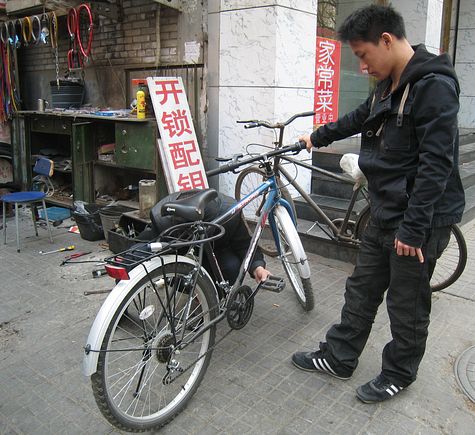
DI_20080311_BeiDa_bicycle_repair.jpg

Eric only paid a few cents for the repair. Remounting the bike and riding a block, the crank fell off again. We returned to the same mechanic, who hammered harder. With the bike repaired, we then set out to see the first campus.

Peking University

From the Zhongguancun part of the Haidian District, we had biked north and then east. To cross over the divided road from the east side of the street, we found a pedestrian overpass. We entered through the east gate of Peking University.
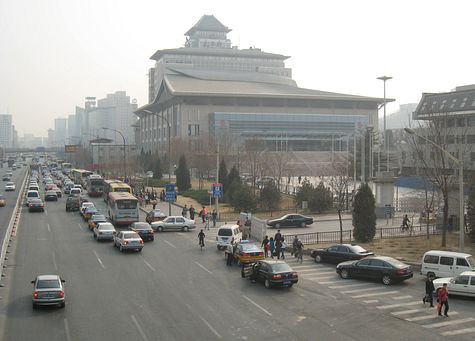
DI_20080311_BeiDa_overpass.jpg

Peking University has been described as the “Harvard of China“. In the southeast part of the campus, the buildings are relatively modern.
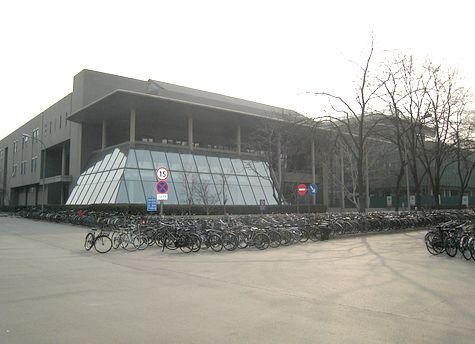
DI_20080311_BeiDa_glass_building.jpg

The number of parked bicycles seemed relatively large in comparison to the number of students walking around. Class was in session.

DI_20080311_BeiDa_walk.jpg

Inside the campus loop, the athletic field is at the south edge of campus.

DI_20080311_BeiDa_athletic_field.jpg

We watched a sports team training, shuffling left and then right. Training exercises seem much the same around the world.

DI_20080311_BeiDa_drills.jpg

Back north, and then west, this grand building opened onto a plaza.

DI_20080311_BeiDa_plaza_building.jpg

Farther north seemed to have older, more human-scale buildings. This covered walkway beside a low-rise building welcomes pedestrians.

DI_20080311_BeiDa_covered_walk.jpg

Near the centre campus, one building was a cross between modern architecture and traditional Chinese features.

DI_20080311_BeiDa_building_stairs.jpg

Swinging around a circular loop, we waited while busloads of tourists took their photographs on the steps in front of the main building.

DI_20080311_BeiDa_main_building.jpg

Back into the campus were some older buildings, and a garden with rock monuments and mossy trees.

DI_20080311_BeiDa_tree_moss.jpg

Beyond the buildings in the north campus, a path led down to WeiMing Lake.

DI_20080311_BeiDa_lake_overview.jpg

It’s likely that many scholars have come by the lake shore to think.

DI_20080311_BeiDa_lake_shore.jpg

In the distance, construction cranes remind the visitor that Beijing is a booming city.

DI_20080311_BeiDa_lake_cranes.jpg

The lake takes some turns in its course, so it’s always possible to find a secluded spot.

DI_20080311_BeiDa_lake_turn.jpg

Across the lake is a traditional Chinese pagoda.

DI_20080311_BeiDa_lake_pagoda.jpg

On the edge of Weiming Lake is the David Packard Pavilion, presented to Peking University at its 100th anniversary in 1998 for use as an International Faculty Residence.

DI_20080311_BeiDa_Packard_Pavilion.jpg

Walking south, pedestrians would ascend stone steps to the campus. On bikes, we pedalled up the incline to the side.

DI_20080311_BeiDa_lake_steps.jpg

The low-rise classrooms in this part of campus were more traditional in architecture, and seem well-maintained.

DI_20080311_BeiDa_red_building.jpg

A bridge spanned the water near the northwest gate.

DI_20080311_BeiDa_bridge.jpg

We exited by the northwest gate to check out the view, and then biked back into the campus to cross to the other side.

DI_20080311_BeiDa_gate.jpg

Following an eastbound route in the north campus, we saw smaller and older buildings. Two columns marked the entry into an enclave.

DI_20080311_BeiDa_columns.jpg

These buildings may have been residences at one time. They’re now offices.

DI_20080311_BeiDa_office.jpg

On bike, the campus was large. On foot, the tour would have been exhausting. We exited by the east gate where we had entered, and back onto the major road.

Tsinghua University

Eric didn’t exactly know where Tsinghua University is located. He usually takes taxis, and the drivers go point to point. We biked east and then north. Some office towers had the logos of high-tech companies familiar to the west. Tsinghua University is known as the “M.I.T. of China“.

DI_20080311_Tsinghua_district_bus.jpg

We found a traffic circle at the entrance to Tsinghua University. We later deduced it was the south east gate. The building immediately to the northeast looked modern.

DI_20080311_Tsinghua_entry_circle.jpg

On the northwest side of the gate was another modern building.

DI_20080311_Tsinghua_gate.jpg

Through the gate, we biked north. This grand building had signage only in Chinese script.

DI_20080311_Tsinghua_modern_building.jpg

As the next building north, the Tsinghua School of Economics and Management had its sign prominently displayed in English.

DI_20080311_Tsinghua_School_of_Economics_and_Management.jpg

At the end of the road going north, the main building of Tsinghua had signs for traditional departments of engineering.

DI_20080311_Tsinghua_main_building.jpg

As we biked west and north, we found many tree-lined streets with low rise buildings.

DI_20080311_Tsinghua_street_bike_EKI.jpg

It was around 5:00 p.m., and we noticed the number of students headed northbound on bikes increasing.

DI_20080311_Tsinghua_street_bikes.jpg

A few minutes later, we recognized that we were in rush hour — with bicycles the dominant choice for transportation. Even with heavy traffic, there were still lots of bikes lined up as parked.

DI_20080311_Tsinghua_rush_hour_bikes.jpg

We chose a route with less traffic by riding west. This took us across a bridge over a canal.

DI_20080311_Tsinghua_canal.jpg

On the west side of the canal, a park area had a walk with benches underneath.

DI_20080311_Tsinghua_covered_walk.jpg

We found the sports fields, where students were training.

DI_20080311_Tsinghua_field.jpg

On the west side of campus was a mix of new and old buildings. We saw one shaped as an observatory might, but it wasn’t very high. Bejing is prairie-flat, though.

DI_20080311_Tsinghua_observatory.jpg

Crossing another bridge on the canal, we decided that we should speed up our tour before the sun had totally set.

DI_20080311_Tsinghua_canal_sunset.jpg

Tsinghua University also has a lake. We biked south on the western shore a bit, and then realized that it would take more time that we had available to go around it.

DI_20080311_Tsinghua_lake.jpg

We left the Tsinghua University campus by the west gate, and continued bicycling south. On the way, we passed by the east gate of Peking University, where we had started sightseeing. We had biked all of the way around Tsinghua University on major streets, when it’s literally “across the street” from Peking University. The amount of time we spent on the bikes illustrates that “across the street” is a relative term. The distance really isn’t walkable.

Renmin University

Riding south, and then west, we wended our way back to the main gate on the east side of Renmin University. Eric is studying Mandarin there, as did Adam for two years. Renmin University of China may not be well known to westerners, but it’s ranked as a top Chinese school for economics and law.

DI_20080311_RenDa_gate.jpg

Directly through the gate is the boulder that appears as the standard image for the university.

DI_20080311_RenDa_boulder.jpg

In the park behind is a pile of igneous rock, forming a natural sculpture.

DI_20080311_RenDa_igneous.jpg

The campus at Renmin University is more compact than the others we visited that day. The function of the girders spanning two towers of this building is unclear.

DI_20080311_RenDa_twin_towers.jpg

Most buildings, as with these classrooms, seemed to favour function over aesthetics.

DI_20080311_RenDa_classrooms.jpg

Newer buildings have had more thought put into their design.

DI_20080311_RenDa_stacked_building.jpg

We biked by RenDa Teaching Building No. 5, where Eric has had some classes.

DI_20080311_RenDa_Teaching_Building_5.jpg

The Renmin University stadium looks relatively new, and is Olympic scale.

DI_20080311_RenDa_stadium.jpg

The sports field behind the stadium was quieter as the sun was setting.

DI_20080311_RenDa_sports_field.jpg

The park was modest, with a small pavilion.

DI_20080311_RenDa_pavilion.jpg

Renmin University has a pond, not a lake.

DI_20080311_RenDa_pond.jpg

The west edge of the campus is abuts to the city, with apartment towers across the street.

DI_20080311_RenDa_walk_towers.jpg

The Mingde Building Complex is a mammoth structure that includes the School of Business, and the Law School. This building opened in 2005, reflecting China’s growing investment in higher education.

DI_20080311_RenDa_Mingde_building.jpg

We ended the day at a restaurant on campus, near Eric’s dormitory.
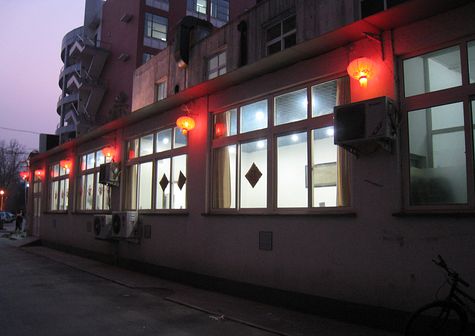
DI_20080311_RenDa_resto.jpg

The restaurant had been recently renovated, so Eric hadn’t eaten there recently. We may not have chosen the best dishes for their specialties.

DI_20080311_RenDa_resto_interior.jpg

It had taken us nearly five hours to bike to and around three university campuses in Beijing. We didn’t dismount for more than 10 minutes at any time, and we hadn’t seen every part of every campus. I’m more accustomed to cities with neighbourhoods that are walking scale. Beijing is the capital of China, and size appears to be one of the dimensions on which the country wants to make an impression

  • RSS feed: Photo Microblog Photo Microblog

    • Cameron Harvey (2026) Ancestor 74
      Floor to ceiling #CameronHarvey (2026) Ancestor 74, from the series Family of Things. Impermanence inspired by chaparral shrub that survived fires in 2024 and 2025 but forever changed. Paint applied to unstretched canvas on floor with feet, knees and hands in symmetry. (Unversity of Toronto Art Centre, University College) 20261114
    • Chiedza Pasipanodya (2026) Machuma | The Cradle
      Shape of fruit from baobab trees, #ChiedzaPasipanodya (2026) Machuma | The Cradle suspends spheres of clay wrapped with herbs and fired from steel frame. Tradition encourages ancestral connectivity and future projection, travelling in and out of time. Part of Toronto Biennial of Art. (University of Toronto Art Centre, University College) 20261114
    • Dala Nasser (2025) Xiloma MCCCLXXXVI
      Recreation of 6th century Byzantine mosaic #DalaNasser (2025) Xiloma MCCCLXXXVI. Title combines ancient Greek for rupture, and Roman numerals for 1386 years before church floor was discoverd in 1862. Cyanotype fabrics were draped across wooden scaffolds exposed to sunlight. Fragmented installation representative of enduring dislocation from ancestral homelands. (Justina M. Barnicke Gallery, Hart House, University […]
    • Soon to be lit Christmas Tree
      Media crews preparing for Christmas Tree to be lit in about 90 minutes, after sunset. Deejay spinning tunes to energize audience positioning for optimal viewing. Barricade fences separating watchers from shoppers, many security guards guiding pedestrian traffic. (Eaton Centre, Yonge Steet, Toronto) 20261112
    • OCADU Field Trip to Contxt by Trane
      OCADU Arts Adminstration class field trip, #FrankFrancis interviewed by #PeterScott behind the science of operating a community space featuring jazz. After Trane Studio building overhead escalated, found welcoming generational landlord for Contxt space. This month, paintings by #HollisBaptiste on exhibition. (Contxt by Trane, Lansdowne Avenue, Toronto, Ontario) 20261105
    • New old mountain bike
      First ride after buying 1999 Kona 16" bike in palmer green off Kijiji. Previously owned two models in early 1990s, regretfully both stolen. Lighter than my other bikes, top reach is shorter, frame feels rigid. (Metropolitan United Church, Queen Street East, Toronto, Ontario) 20261104
    • Third visit to passport office
      Third visit to drop off grandson's passport application in person, not applying in California required confirmation by supervisor. First visit required letter from father, second visit requested photo with clearer stamp. Return via courier in 10 business days. (Toronto Passport Services, Victoria Street, Toronto, Ontario) 20261102
    • Halloween in the Upper Beaches
      Convened in neighbourhood enclave with grandparents-in-law for Halloween. Granddaughter hasn't yet reached first year, toured other homes for treats. Children's parade on street before sunset. (Upper Beaches, Toronto, Ontario) 20261031
    • Rebecca Baird (1993) A Time Within a Memory
      Created in collaboration with basket weavers from Walpole Island, #RebeccaBaird (1993) A Time Within a Memory. Sweet grass, seed beads, wood beads, porcupine quills, cotton thread. Part of the Returning to Ourselves exhibition, on loan from Global Affairs Canada Diplomatic Art Collection. (Onsite Gallery, Richmond Street West, Toronto, Ontario) 20261028
    • Michael Massie (2026) Do You Get the Point!
      Reimagining of child putting daisy into soldier's gun, #MichaelMassie (2026) Do You Get the Point! is a quieter bow and arrow. Brass, copper, woods, sinew. A more recent work in the Now and Then exhibition. (Onsite Gallery, Richmond Street West, Toronto, Ontario) 20261028
  • Meta

  • Fediverse daviding.com

  • Translate

  • Recent Posts

  • Archives

  • RSS feed: on Coevolving on Coevolving

    • Scholarship on systems theory and complexity in an age of Generative AI
      I’m impressed at the scholarship of Mark Downham, with the November 14 release of “Humans Are Not Estuaries“.  This work was in response to the November 13 release by Dave Snowden on “Not a branch of the tree” as part of the “What Is the Same and What Is Different series to position Anthro-Complexity”. What […]
    • Stephan H. Haeckel (1936-2025)
      I feel that I should honour Stephan H. Haeckel, who was the person that led me into #SystemsThinking in 1998 while on an assignment to the IBM Advanced Business Institute in Palisades, NY. Steve was working on Adaptive Enterprise: Creating and Leading Sense and Respond Organizations that was published by HBS Press in 1999. We […]
    • Problematique Dialogue 2026 retrospective
      From May 10-15, 2026, sLab convened the first Problematique Dialogue applying the Banathy Conversation Methodology, in the Graduate Studies building of OCAD University.  This brought together 26 participants in four teams, four facilitators, two methodologists, and two student volunteers. Ashok Mathur, VP of Research and Dean of the School of Graduate Studies, opened the event […]
    • Problem Solving, Problem Seeking
      As teams have been meeting online in preparation for the Problematique Dialogue event in May, there are some questions related to the Banathy Conversation Methodology.  There’s an emphasis on generative dialogue, over strategic dialogue. In the dialogue scholarship community there is a shared understanding that dialogue is not a new tool for addressing specific issues […]
    • Re-introducing sLab, Problematique Dialogue Call for Participation, 2026-02-25
      At OCAD U Graduate Programs, we convened an event to formalize (i) Re-introducing sLab, and (ii) announcing the Call for Participation for the May 2026 Problematique Dialogue, applying the Banathy Conversation Methodology. Peter Scott served as the moderator for the afternoon.  Greg Van Alstyne spoke about the sLab, as a unit first founded in 2008, […]
    • Problematique Dialogue + Conversation as Process and Connection | Systems Thinking Ontario | 20260209
      With a history of Banathy Conversations hosted by the International Federation for Systems Research (IFSR, 1982-2018) and the Creative Systemic Research Platform Institute (CSRP, 2024, 2025), the 139th meeting of Systems Thinking Ontario online was scheduled to provide more background on an upcoming in-person event planned for Toronto. Since fall 2025, the reinvigoration of the […]
  • RSS feed: on Media Queue on Media Queue

  • RSS feed: on Ing Brief on Ing Brief

    • 2026/01/07 | Rama Akkiraju | From LLMs to Living Systems: Applying Systems Science to Agentic AI in the Enterprise | HICSS-59 Keynote
      Abstract Enterprise AI is transitioning from simple single-LLM flows to complex agentic ecosystems—adaptive systems composed of multiple agents, tools, governed data, human workflows, and organizational policies. This keynote introduces a systems-science framework for designing and managing such ecosystems using principles of modularity, control, feedback, robustness, and socio-technical alignment. We illustrate these concepts through practical examples […]
    • Timothy F.H. Allen passed away on May 01, 2025
      Timothy F.H. Allen, president of International Society for the Systems Sciences 2008-2009, passed away peacefully in his home, surrounded by his family, on May 1, 2025. With his work on ecosystem ecology, I learned more about living systems than anyone else in the systems community. After his retirement, he was proud of putting together a […]
    • Installing WordPress Studio on Manjaro Linux
      In 2024, WordPress Studio was released, making installation on a local computer simpler. The instructions were modified from MacOS to Ubuntu Linux, by Daniel Kossmann, “How to install WordPress Studio in Ubuntu Linux” | Jun 15, 2024 at https://www.danielkossmann.com/how-to-install-wordpress-studio-ubuntu-linux/ I already had NVM installed, but in Terminal, with the result “command not found”. In the […]
    • Notion of Change in the Yijing | JeeLoo Lin 2017
      The appreciation of change is different in Western philosophy than in classical Chinese philosophy. JeeLoo Lin published a concise contrast on differences. Let me parse the Introduction to the journal article, that is so clearly written. A-theories divide time into past, present and future, and the point of reference is set at “the present.” B-theories, […]
    • World Hypotheses (Stephen C. Pepper) as a pluralist philosophy [Rescher, 1994]
      In trying to place the World Hypotheses work of Stephen C. Pepper (with multiple root metaphors), Nicholas Rescher provides a helpful positioning. — begin paste — Philosophical perspectivism maintains that substantive philosophical positions can be maintained only from a “perspective” of some sort. But what sort? Clearly different sorts of perspectives can be conceived of, […]
    • The Nature and Application of the Daodejing | Ames and Hall (2003)
      Ames and Hall (2003) provide some tips for those studyng the DaoDeJing.
  • Creative Commons License
    This work is licensed under a Creative Commons Attribution-NonCommercial-ShareAlike 4.0 International License
    Theme modified from DevDmBootstrap4 by Danny Machal